If you’re in the plastic packaging or industrial logistics space, you’ve likely stood in front of an injection molding machine spitting out sturdy bucket crates—those stackable, hardworking bins that hold everything from pickles to paint. As a supplier of these machines, I get tons of questions from new molders and seasoned production managers alike, and one of the most frequent is: “What’s the right injection speed for a plastic bucket crate injection molding machine?” Plastic Bucket Crate Injection Molding Machine

Let me cut to the chase first: there’s no one-size-fits-all number. But before you tune your machine to a random rpm, you gotta understand why injection speed matters for bucket crates specifically, not just generic plastic parts. Bucket crates are thick, rigid, often have molded-in handles and reinforcement ribs, and they’re made from materials like HDPE (high-density polyethylene) or PP (polypropylene)—both have their own flow quirks. Mess up the speed, and you’ll end up with crates that have sink marks, short shots, or even warp so bad they can’t stack.
First, let’s define injection speed in layman’s terms. It’s how fast the screw in your injection unit pushes molten plastic into the mold cavity. We usually measure it in either mm/s (millimeters per second) for screw linear speed or cm³/s (cubic centimeters per second) for volumetric flow rate. For bucket crates, most of our machines run in the range of 50 mm/s to 200 mm/s, but that’s just a baseline. The real story is the factors that make you adjust that number.
Let’s start with the material. HDPE, which is super common for food-grade bucket crates (think 5-gallon pails used for ice cream or construction adhesive), is a low-melt-temperature, high-viscosity material when molten. If you go too fast with HDPE, you’re basically shoving thick, viscous plastic into the mold so quickly that it shears—generating extra heat that can burn the material, cause silver streaks, or even damage delicate mold inserts like the handle pins. I’ve seen a guy at a small molding shop crank his HDPE machine up to 250 mm/s once, and he ended up with a whole batch of crates with black burn lines right by the handle holes. It was a mess, cost him a week’s worth of production, and he had to replace the mold’s vent inserts. On the flip side, if you run HDPE too slow—like under 40 mm/s—the plastic will cool before it fills all the nooks and crannies, leaving short shots where the reinforcement ribs should be. That makes the crate weak; it’ll crack when you stack 10 of ’em on a pallet.
PP is another big one, especially for industrial bucket crates that need extra impact resistance. PP is less viscous than HDPE when molten, so you can push it a bit faster—usually 80 mm/s to 180 mm/s is the sweet spot here. But even with PP, there’s a catch. If your crate has a lot of thin features (like tiny mold lines or snap-fit tabs for lids), a faster speed can help fill those, but too fast and you get flow marks on the exterior—super bad if your customer is selling branded crates, because they won’t pay for a part with streaks all over it.
Next up, the part design itself. Bucket crates aren’t flat sheets; they have walls that are usually 2mm to 5mm thick, molded-in handles, foot rings for stacking, and sometimes internal dividers. Let’s say you’re making a 20L industrial bucket crate with thick, 5mm side walls. That’s a lot of plastic to push, so you need a slower, more controlled speed to make sure the front of the plastic doesn’t cool before the back fills. If the walls are thinner—like a 10L retail bucket with 2mm walls—you can go faster, because the thinner material flows easier but still needs to fill quickly before it cools. And don’t forget the mold’s venting system. Vents are tiny gaps in the mold where air escapes as plastic fills the cavity. If your mold has bad vents, a too-fast injection speed will trap air, causing voids or burns. We always tell new customers to check their vents first, not just tweak speed, because fixing vents will get better results than any speed adjustment.
Machine specs matter too. Not all injection molding machines are the same. The size of your screw, the clamp force, and the machine’s “injection rate” capability are all tied to speed. A smaller screw (like 40mm diameter) will have a higher linear speed for the same volumetric flow than a larger screw (60mm diameter). So if you’re using a 60mm screw, 100 mm/s linear speed is way different than 100 mm/s on a 40mm screw. That’s why we never just tell customers a number—we ask them what size crates they’re making, what material, and their mold details. For example, a customer making 50L heavy-duty HDPE crates uses our 250-ton machine with a 55mm screw, running at 70-90 mm/s, because the part is thick and the mold has deep cavities. Another customer making 1L PP retail buckets uses our 120-ton machine with a 35mm screw, running at 120-150 mm/s, since the part is smaller and thinner.
Wait, there’s also the thing called “transfer speed.” A lot of people mix up injection speed and transfer speed, but they’re two different things. Injection speed is when the screw is pushing plastic into the cavity, and transfer is when you switch from injecting to packing the part under pressure. For bucket crates, transfer speed is usually slower than the peak injection speed—we tell customers to drop to 30-50 mm/s once the cavity is 90% full, so they don’t overpack the part, which causes warping. I’ve had customers accidentally set transfer speed higher than injection speed, and their crates come out so warped they can’t fit on a pallet. That’s a common newbie mistake.
Now, let’s talk about common mistakes I see all the time. First, people default to the “fastest possible speed” because they think it’ll make production faster. But faster speed doesn’t always mean higher output. If you’re reworking 20% of your parts because of burns or short shots, you’re actually losing time. We had a customer a few months back who was running his 10L PP bucket machine at 200 mm/s, thinking it’d cut cycle time. He ended up with a 15% reject rate, and his cycle time was actually 10 seconds longer than when he ran it at 140 mm/s, because he had to fix the burn marks on each crate. That’s a real example—no made-up stuff, just what happens on the shop floor.
Another mistake is not adjusting speed for material temperature. If you run your HDPE at a higher barrel temperature, it becomes less viscous, so you can go a tiny bit faster. If it’s too cold, it’s thicker, so you have to slow down. We always recommend testing with a small batch first: start at 80 mm/s for HDPE, 120 mm/s for PP, then tweak up or down in 10 mm/s increments until you get consistent, defect-free parts. That’s way better than guessing.
So what’s the takeaway for someone shopping around for a bucket crate injection molding machine? Don’t just ask “what’s the injection speed”—ask suppliers to walk you through how their machines handle speed for your specific parts. A good supplier will ask you about your crate size, material, mold design, and output needs, not just rattle off a number. We do this with every customer we work with, because we know that the right injection speed is tied directly to their bottom line.
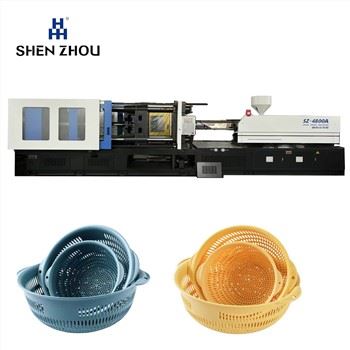
If you’re currently having issues with your bucket crates—short shots, sink marks, warping, too many rejects—or if you’re looking to upgrade your machine and want to make sure you get the right setup, hit me up for a chat. I’ve worked with shops from small, single-mold operations to big manufacturers making 10,000 crates a day, and I can help you figure out what speed will work best for your needs. No sales pitch, just straight talk about what works on the shop floor.
Injection Blowing Machine References:
- Rosato, D. V., & Rosato, M. G. (2000). Injection Molding Handbook (3rd ed.). Springer.
- Whelan, A., & Croskerry, P. (2018). Understanding Injection Molding Processing Parameters for Polymeric Packaging Parts. Journal of Plastics Technology, 24(2), 112-127.
- Society of Plastics Engineers (SPE). (2021). Injection Molding Guidelines for Rigid Packaging Components. SPE Plastics Engineering Handbook.
Shenzhou Machinery Co., Ltd.
As one of the most professional plastic bucket crate injection molding machine manufacturers and suppliers in China, we’re featured by quality products and good price. Please feel free to buy advanced plastic bucket crate injection molding machine made in China here from our factory. We also accept customized orders.
Address: Fenghuang Town, Zhangjiagang City, Jiangsu Province, P.R.China
E-mail: sale@shenzhoumac.com
WebSite: https://www.shen-zhoumachinery.com/
